Friday, 14 May 2010

Flying to the Monaco GP, part 2

Given the size of the Commander's fuel tank, the expected headwinds, and the size of the aircraft occupants' bladders, the trip to the south of France was to be taken in two legs.  We needed somewhere half way along the journey to Cannes (LFMD) that had customs and immigration, fuel and a restaurant nearby.  A few years ago, Bourges (LFLD) was chosen for this purpose.  On that occasion, the place was deserted and we were left at the mercy of the local aeroclub who required cash for the fuel.  Fortunately one of the passengers had changed a lot of money to Euros prior to the trip so we could make this work.  I was assured that this was not normal, and that there was usually someone in the tower, and a fireman who doubled up as a fuel dispenser from the locked pumps.

The route chosen to get from Fairoaks to Bourges was GWC N859 SITET A34 KOVAK H20 DOMOD A3 GILUX.  I realise that will mean nothing to most people (me included) without a map so here's the route we intended to fly:

The route from Fairoaks to Bourges

The kinked route is required to follow airways - defined routes in the sky that IFR aircraft are required to follow.  Sort of.  More of that shortly.  The plan said that this would take 2 hours and 15 minutes, departing at 10:00am.  Given the earlier delays, we were running a bit late and finally managed to depart Fairoaks at 10:25.  The kinked route represents an increase in route length of 6% of flying in a straight line between the two airports.  This is a very good result for routing around Europe.  15-20% increases in distance flown aren't uncommon.

After takeoff form runway 24 we turned left and headed for Goodwood (GWC) and contacted Farnborough Radar.  Our takeoff clearance was to 1400', but on contact we were cleared up to 3400' to keep us below some other traffic.  Once clear of that this was lifted to 6000', and before reaching that all the way up to our cruising altitude of FL100.  In the climb over the southern shores of England and into the channel we went through a broken layer of cloud which dissipated altogether once over the English Channel.  Passing over Le Havre on the French coast there was little more to do than admire the scenery and occasionally make contact with the next ATC unit along the route.  This is what IFR touring is about - the flying is easy!

As we approached Bourges we were given descents in good time so down we went through some fairly thick clouds that had been increasing the further south we went.  We picked up quite a coating of ice in the descent, over a centimetre on the temperature probe and leading edge of the wings and a thin coating on the windscreen.  No doubt the leading edge of the tailplane had some, too.  As soon as we descended through 5000' and the temperature outside became positive, the ice came off quickly.

The Paris controller we talked to informed us that the Bourges tower was currently unmanned, and was very insistent that we take down and confirm a phone number to call to close out flight plan once on the ground.  At a manned airport, ATC will do this for you.  Failure to close an IFR flight plan will result in the search and rescue services coming to look for you, and in France they will send you the bill for their troubles!

We landed 2 hours and 20 minutes after takeoff, making us half an hour late as compared to our planned arrival time.  We pulled onto the parking area near the fuel pumps and set about trying to find someone to unlock them and dispense some avgas into the aircraft.  After a small amount of investigation, the fireman/fueller appeared from a locked door and we managed to convey the message to him that we'd really appreciate some fuel.

The intention had been to walk into Bourges for lunch, but given our late arrival and the need to be off again at our flight planned time just 25 minutes later, I asked the fueller what was nearby.  The best he could come up with was a McDonalds, but at least it had free wifi so I could check in on the weather further along our route.

The route we had filed onwards to Cannes was MENOX R31 MTL R161 AMFOU, which is again just 6% longer than the direct route.

The route from Bourges to Cannes

On our return to the aircraft, the fueller came over as he saw us loading up to inform us that we had a departure slot, and to go up the tower to see the controller.  Jerome's English was much better than the unnamed fireman, and he was able to tell us that we had been given a departure slot, delaying our flight plan by 45 minutes.  This meant that we were now not due to depart for an hour.  We filled the time by chatting with Jerome, checking the weather inbetween Bourges and Cannes, reading about the F1 news on the PC with an internet connection and before long it was time to head down to the aircraft and be on our way.  After a short backtrack we launched into the cloudy sky and headed south.

The climb up to FL100 for the cruise would take us through clouds that were likely to contain the same icing conditions as those we had descended through.  I decided that as we knew the tops were below our intended cruising altitude we would try to get up through them and allow the ice to sublimate off in the sunshine above.  Sure enough, as we climbed above the freezing level the ice began to accumulate.  100kts - my usual climb speed - was fine for the first few thousand feet, but in order to maintain the climb we came back to Vy, 94kts, at about FL80.  The ice was starting to get uncomfortably thick, and the last few hundred feet, with the brightening near the top of the clouds was agonising.  I wasn't far off making the decision to descend back to warmer levels when we popped out of the top and crawled up to FL100.  The ice did gradually sublimate and our cruise speed rose as the airframe became clearer.
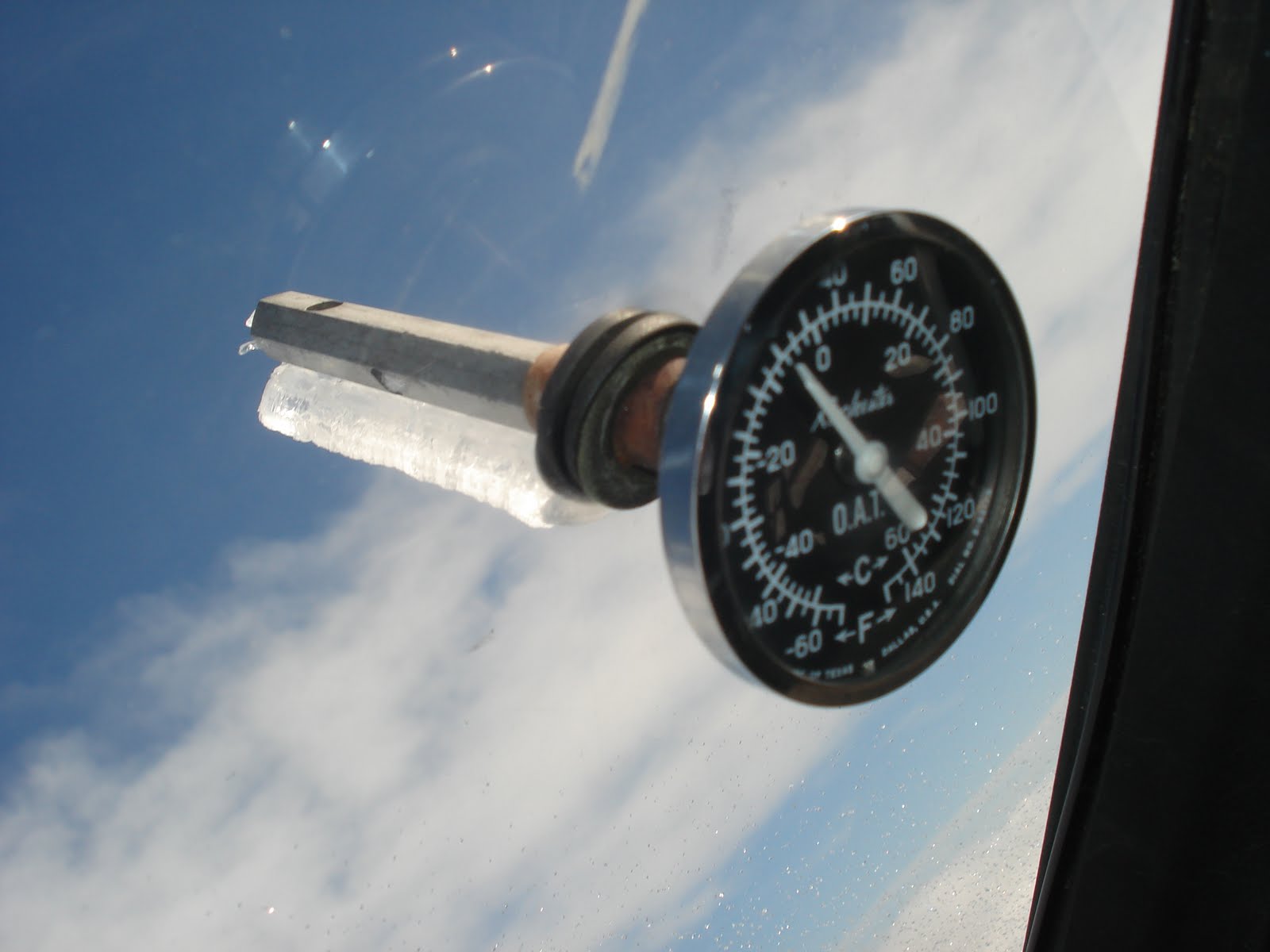
Ice sticking to the OAT probe

We were given clearance to route all the way to the MTL VOR, some 150 nautical miles away.  As the route was fairly straight anyway this didn't make too much difference, but was good to hear nonetheless. We could see the cloud tops rising to meet our level ahead, so I requested a 1000' climb to FL110 which was readily granted and kept us clear of the clouds and further icing conditions.  The temperature outside was a chilly -6C and I'm sure the ice would have stuck to us at an alarming rate.

As per the forecast we'd seen both at home and in Bourges, there were a few buildups which rose above the FL100 or so cloud tops to something like FL140, and one of these was right in our way.  A quick request to ATC to deviate right to avoid weather was granted and so we did.  When we were approaching a point at which we could turn back towards MTL ATC asked us how long before we would be able to do so; I told them another 5 minutes would do it and they seemed fine with this answer.

The weather system that was bothering south eastern France came with some winds, and typically these were headwinds for us (aren't they always?) with the result that the 2:10 planned flight took us 2:45 making our touchdown time at Cannes 6:50pm.  We taxyed straight to the fuel pumps, reasoning that a short delay now was better than any delay on the return journey and potentially missing our flight planned departure time or slot if we had one.  We pulled up at pump 2 as there was a Jodel already waiting at pump 1, but there were no fuellers to be seen.  The Jet A1 truck was out fuelling up the business jets of the rich and famous - the Cannes film festival is on at the same time as the Monaco grand prix, making this weekend Cannes airport's busiest throughout the year.  I checked with the Jodel pilots, and found out that they had been waiting just a few minutes.  Before long an airport official came over on a golf cart to tell us that the fuellers would be along in about 20 minutes.  I asked if we would be better waiting until Monday morning and he confirmed what we thought; that the potential for delays on Monday was far greater.

Something like 30 minutes later, the fueller arrived.  All he had to do was throw a switch to enable the pumps.  Surely he could have taken 30 seconds from his jet refuelling time to do that for us!  Another aircraft had joined the fuelling queue in the meantime.  I dispensed the 115 litres of avgas (not bad for 2:45 of flight!) paid in the fuel office and we all boarded again to taxy to our parking stand.  The ground controller asked how long we would be staying and after confirming that (as booked) we were there for the weekend, we were directed to park on the opposite eastern side of the airport on the grass.  After parking the aircraft we unloaded our luggage and a neat airport van collected the crew of an aircraft parked next to us.  We were ready moments after they had driven away but thought they would be back soon.  25 minutes later, and (sod's law) with me having unpacked a headset and climbing into the aircraft to call ground and ask how much longer we would be expected to wait, the van returned.  It proceeded to collect 5 more people from helicopters that had landed in the meantime and then return to the terminal.

There was just one taxi waiting, so while the others collected our luggage I was out of the van door first and went straight to the driver, asking him to take us to the train station.  Finally, something had happened without any delay!

Flying to the Monaco GP, part 1

For the last few years, myself and another pilot have made our way to Cannes (LFMD) with the ultimate aim of attending the Monaco Grand Prix.  The routes have been varied, and each year we take another passenger or two but to date have always been in four seat single engine piston aircraft.  This year, as last year, we would be making the journey in my Commander.  The passenger would be my father and the simplest way to achieve this, with the Commander being based at Liverpool, my dad near Gloucester and Mark in the London area, would be to make a couple of stops to collect people on the way.

This year we chose not to be there for the practice sessions on Thursday.  At most Grands Prix, these are on the Friday but Thursday practice is just one of the many ways that Monaco is a bit different to the rest.  We chose, therefore, to fly down on Friday and return on Monday.  After work on Thursday afternoon, I drove to the airport and made a simple VFR flight to Gloucester at around 2,000ft.  There is very little in the way of airspace between Liverpool and Gloucester so once out of the Liverpool zone at Chester the routing is a case of telling the GPS I want to go to EGBJ and following the magenta line.  On radio contact with Gloucester I offered to make an SRA approach as they are currently training new controllers but was told that the trainee wasn't around so I made a simple right base join for runway 22.  In order to save some time in the morning, I fuelled up at this point before parking for the night and being collected to spend the night with my parents.

En route to Gloucester

Returning the next morning with the intention of being off blocks at 0900, we ended up moving at about 0920.  After beginning the taxi to the threshold of runway 22, we were asked to wait for a locally based training twin.  This proceeded to take a rather long time for the student to complete checks at the holding point, then longer to receive an IFR clearance, even longer to put up IR screens and ended up delaying us by more than 10 minutes.  Would it really have been such a pain for them to taxi behind us?  Gloucester is normally a slick operation but this was a poor example of sequencing.

We set off in the direction of Fairoaks (EGTF) and again the navigation was little more than a straight magenta line between the two.  With the help of Brize Norton allowing us to cross their zone and a very short dogleg towards the end to avoid the south western point of the Heathrow CTR the flight was uneventful, culminating in a downwind join for Fairoaks' runway 24.  Mark was waiting for us at the aircraft's parking spot and within 10 minutes we were starting the engine again for the IFR next leg into France...

Saturday, 10 April 2010

Flying something bigger

Today saw the PPL/IR spring meeting, and the descent upon Cambridge Airport of lots of Instrument Rated pilots.  There were interesting talks on IAP design, flying GPS approaches and survival equipment as well as a chance to chinwag with like minded individuals.

The Commander was booked out by another group member for the weekend to take over to Dublin, so I was left without a steed for the day.  A couple of phone calls to contacts turned up a spare seat (or 5!) in a Cessna 340A, G-CCXJ going to the meeting from Liverpool.  A quick call to the pilot concerned and he was only too happy to have me along.

Cessna 340A G-CCXJ

The Cessna 340 is a 6 seat, pressurised, twin turbocharged engine light twin.  It is considerably heavier than the Commander at almost twice the weight, and is certainly much larger.  After entering via the clamshell airstair, I made my way up to the right hand seat as Paul started her up.  We were quickly on our way and at 165kts, and I was given control.  Once airborne, there really isn't that much different to flying this type of aircraft than those I have flown in the past.  In under an hour, we were making contact with Cambridge and after holding outside their ATZ for a couple of minutes due to the volume of incoming traffic we were invited in to join on crosswind for runway 23.  I flew into the circuit but handed back control for the tight turns to final and the landing as this wasn't the situation to be going around!

It was a beautiful day so to avoid the heat inside getting uncomfortable for the return trip, we left the upper half of the clamshell door and the storm windows open.  A wise move - no stuffiness detected when we climbed back in later on!  I went up front and sat in the right had seat again while Paul did the walk around.  When he came back he asked if I'd like to conduct the return flight from the left hand seat!  Never one to pass up an opportunity I slid across and belted myself in.  As most of the switches including engine start controls are only accessible from the left seat, Paul guided me through starting the engines and preparing us for flight and then simply instructed me to taxy.  Again, this isn't too dissimilar to any other aircraft I've flown except for the use of differential thrust to turn tightly.  As the name implies, if you need to turn tightly you advance the throttle on the outside engine which in combination with the normal nose wheel steering helps get you round without too much effort.

After a short briefing on applying the throttles for takeoff - this aircraft has automatic wastegate control so no danger of overboosting the turbos - we were off, climbing at 130kts and over 1500fpm.  A left turn out and course set for Liverpool had us levelling at 4000ft and the day called for nothing more than VFR flying.

En route, Paul wanted to empty some of the fuel tanks as we had been left in an unbalanced situation and this needed to be rectified.  This involves flying using a very nearly empty tank until the fuel flow drops, indicating that the tank is now truly empty, and then switching to an alternate tank.  If the switch happens in time, the only indication is from the fuel flow meter and there is no drama at all.  This is exactly what happened.  At least, on the first tank we ran dry!  It seems that we weren't quite ready for the second one so the left engine did actually lose power.  Despite the dire warnings that an engine failure in a twin is a terrible thing to behold, at least in the cruise it's almost a non-event.  The dead engine/dead leg mantra is not even thought about as the engine loses power and it's an instinctive reaction to press the correct rudder pedal to keep the aircraft balanced.  I'm told (and firmly believe) that at slower speeds an engine failure is most certainly an event and will take the full attention of the twin pilot to control.  In our case, resetting the fuel selector position brought the engine back to life and my first twin engine failure was over almost as quickly as it began.

After a steady descent the familiar entry via Oulton Park into Liverpool's airspace was easily accomplished, and following an orbit at the south bank of the river Mersey for traffic reasons, we joined on a left base for runway 09.  Paul was generous (and trusting) enough to allow me to fly 'XJ all the way onto the runway and taxy her to the parking spot back on the GA ramp.

It was a fantastic day out - a wonderful day to fly, the chance to fly something new and an interesting meeting at the other end.  My thanks to Paul for the opportunity to conduct the flying and the lift to Cambridge, and to PPL/IR for organising the event.  It's just a shame Paul's not an instructor so I can't log the flight!

Tuesday, 16 March 2010

Mothers Day at Gloucester

Yesterday, Sunday March 14th, was Mothers' Day here in the UK.  With that in mind, I thought it would be fun to fly to the closest airfield to my parents' home and spend the day.  That airfield just happens to be Gloucester and as a result of its location and great facilities, I have visited numerous times.  There is very little in the way of controlled airspace en route once clear of the Liverpool zone so with blue skies and a few fluffy white clouds, it was easy enough to go VFR.

On takeoff from runway 27, we took a 90 degree left hand turn to leave the Liverpool zone at Chester.  Gloucester is pretty much a straight line south from there, so that's what we did.  For ease of navigation, the GPS was set up to give a track direct to Gloucester and as the mushroom of Manchester's controlled airspace rose above us, we climbed with the intention of getting over the broken cumulus clouds and into smoother air.  This could have been done completely in VMC, but with an IR it was easier just to pop through clouds in front of us rather than go around them.

Straight through the clouds

We eventually levelled out above the clouds at FL75 and sat there in the sunshine and smooth air looking through the gaps to the ground below.  The further south we went, the more broken the clouds became, until when it was time to descend at a leisurely 500fpm we didn't enter any clouds and remained in the sunshine.

Arriving at Gloucester was simplicity itself; on request we were given a right base join for their runway 27 and positioned for this, slowing down to a more sedate 100kts before we joined the last part of the circuit and made a comfortable descent to the runway, stopping in less than half the distance available.  I have visited plenty of times and knew that a landing on 27 would involve a backtrack to park so aimed not to use up too much runway.  As expected, we were given a backtrack to the fuel pumps and then to park up in front of the fire station.

We were collected from the terminal and whisked away for lunch with my parents.  A wonderful bacon roast had been prepared at the family home and we spent a very pleasant afternoon chatting away and looking at new photos - all the usual family things!

With an night qualification (and now IR) there was no rush to get back to Liverpool before it went dark as has so often been the case over the past few years.  The limiting factor this time was that Gloucester closes at 1800.  For an easy journey back, I filed IFR via TELBA (overhead Telford) at FL70 departing at 1745.  The plan worked perfectly, with the checks complete and brakes released within a couple of minutes of the planned time.  Clearance was exactly as filed and with a right turn on departure we headed for TELBA in the climb.  Gloucester closed just a few minutes later, and asked who we would like to contact next.  I changed over to London Information and was given their 1177 squawk.  As we were still outside controlled airspace, they negotiated with Liverpool to hand over at Shawbury so we set course for the SWB VOR.

Shortly before we got there, a new controller on shift at London Information handed me over and I was given a direct LPL entry into the Liverpool zone.  A gentle descent to duck under Manchester's mushroom of airspace and join at 2000' worked out very well.  Once in the zone, and now night-time, we were put under a radar control service and given vectors for the ILS to runway 27.  This initially involved a right turn to give us enough of a run-up so I'm not sure why we weren't asked to join the zone as usual at the WHI Whitegate NDB; I doubt the extra distance flown took more than a minute so it's hardly important.

Short final at Liverpool

After an accurately flown ILS (with the runway in sight all along, though I didn't look up!) and a smooth night landing we taxied back to the GA apron to find the handling staff there waiting to load the aircraft onto the tug and put her to bed in the hangar for the night.  They were perfectly happy for us to remain sat in the aircraft while they did this and I filled out the logs as we were pushed around.

I ended the day with the familiar satisfied feeling that flight causes in pilots and slept like a baby.  Roll on the next trip!

Saturday, 13 February 2010

Back to Shoreham, IFR

First up, an apology.  I forgot my camera so you'll have to make do with the limited capabilites of my iPhone.  Sorry!

Today was a day to go flying.  It was nice down low and this flight would have easily been possible VFR, but holding a new IR I need some experience.  Shoreham was a run I'd done a couple of times during my training so thought I'd give it a go myself.  There was the added bonus of an offer of lunch being bought for me at the other end, and if you don't think too hard, that seems like a good deal.

The flight plan was put in at home using the fantastic (and free!) EuroFPL.  The route was filed as NANTI L10 HON N615 MID which is basically a straight line to Shoreham.  I'm told that one is not very often allowed to fly the filed route in UK/European airspace and this is exactly what happened.  We were given a non-standard departure from runway 09, turning right to heading 180 and onto Scottish Control from there.  Yes, as of a couple of weeks ago, aircraft heading south from Liverpool talk to Scottish Control.

After being held for about 15 minutes for a string of Ryanair, Easyjet and Flybe departures and arrivals, we were sent on our way.  The route we actually flew consisted of a lot of headings and a continuous climb up to FL90 for the cruise, being cleared in stages but each time well before we'd reached the previously assigned level.  The air up there was wonderfully smooth, enough that my passenger for the day dozed off in the cosy cockpit!

Dozing at FL90

With the autopilot on heading mode, there wasn't too much to do besides monitor the flight and aircraft and make sure all was going to plan.  We were at one point given "direct HON" to take us to the Honiley VOR, which had me thinking we might end up back on our filed route.  This was just prior to a handover to a new sector and as soon as that was complete we were put back on a heading.

Bonus points for anyone able to work out the TAS from the above image

Once we were handed over to London Control, things got busy.  I was about to request a descent when we were given one - excellent!  This continued until we were handed over to Farnborough Radar, with the descent continuing in stages until we were below the cloud and with 10nm to run I requested a change to Southend Approach, which was approved with the change of squawk to 7000.  As we were now below cloud and in VMC, I though there little point in doing the full NDB/DME procedure and requested a visual approach.  This is an IFR thing and basically means that you'd like to do a normal VFR join and circuit but to still remain on your IFR flight plan.  We therefore joined along the coast for left base for runway 02, reporting at Worthing pier.  With a friendly "Welcome to Shoreham" after 1:15 of flying and taxi instructions from the tower after landing, it was time for lunch.


With that ordered in Shoreham's lovely art deco terminal building, I got on with filing the flight plan for the return trip.  I had prepared this earlier in the EuroFPL interface, but had left the filing so that I could choose a suitable time.  At something like 1:30, I chose to file the return plan for 3:00.  As is usual (and guaranteed!) with EuroFPL, I received the ACK message within a minute.  Lunch and chatting were pleasant and 3:00 was getting awfully close.  I used another free and quick part of EuroFPL and submitted a 30 minute DLA (delay) message.  Again this worked perfectly and when I called Shoreham tower for start, they knew what was going on.

The filed route for the return was MID N615 WOD A47 LIC Y53 NANTI, not too dissimilar from the flight down.  This was accepted but our clearance was to make a left turnout from runway 02 and head for GWC before calling London Control for entry into CAS.  This was given by climb on track to GWC, and once entered, we were given right turns to head us in the direction we wanted to go.  At one point, we were given "direct CPT, direct HON" which again seemed a lot like getting us on our planned router, but again was changed before it amounted to much.

Broken cloud over Oxford

Somewhere around Stoke on Trent, I requested a descent, with the little experience I have showing me that Control would have been happy to hand me over to Liverpool at FL90 needing to get down to 2000' or so to intercept the ILS.  I was given a descent to FL60 and handed over.  I hadn't requested this quite soon enough, so was vectored around a big S in the sky to get down to the levels required to got on the ILS for Liverpool's 09.  Despite being in VMC below about 3000', I did the full ILS whilst trying to stop myself from looking up.  It was better than last time though the winds were rather less challenging today!  A simple hour and a half of flying, proving that IFR is a wonderful way to go.

I have a small GPS logger which I take on all my flights so they can be reviewed in Google Earth later on.  This was very useful during my IR training but I continue to use it.  Perhaps I will post the results here.

Saturday, 23 January 2010

First IFR flight

Last month I passed my IR test.  Today was the day to go and do that first IFR flight and also to blow away the cobwebs having not flown since before Christmas.  After cancelling a flight last weekend thanks to a strong crosswind at Liverpool, today looked like being the day.  The first thing to check from home was the weather, and I now wish I'd kept the data I gathered so I could post it here.  In essence, it was okay on top of the clouds, with tops at about 2,500' to 3,000', and not so nice below.  Very low visibility and cloud bases were around, but forecast to improve so I set off for the airport.  By the time I was there, the visibility was up to about 3km and the cloud base had lifted to 500'.  Pre-IR, I would undoubtedly have cancelled the flight last night and had a lie-in, but I now view this weather as perfectly acceptable!

I'd filed a flight plan earlier in the morning to go at F090 in a NANTI 2T departure from Liverpool, then following the L10 airway to HON, the Honiley VOR and then direct to Gloucester.  My clearance was exactly as filed and we lined up on runway 27.

Before being cleared to take off, I was asked to abandon the NANTI 2T departure and climb straight ahead to 4000'.  That read back, we were cleared and away we went, entering cloud at a few hundred feet.  Just to add a bit of distraction, the gear warning light wouldn't go out.  Back to basic training now - first thing to do with any fault is to carry on flying the aeroplane!  So onwards - flaps up, climb power set, and a couple of minutes later we popped up into glorious sunshine.


The autopilot set on heading mode and the Commander trimmed to continue the climb, I cycled the gear.  It lowered fine - three greens and the warning light out.  Raising it again was a repeat of the first attempt - green lights go out but the warning light remained illuminated.  Oh well, we were going to have to land at some point so no reason to concern myself with it for now.  I did limit flight to the 130kt max gear operating speed, though.

Liverpool radar asked if we really needed to go down the airways or if we'd be happy to fly direct to Gloucester from our current position.  With barely an aircraft in the sky, I replied that I'd be happy to go direct, so was given own navigation to Gloucester, continuing climb up to flight level 90 and to contact Manchester Control.  We stayed with them for less than 5 minutes before leaving controlled airspace and being handed over to London Mil for a traffic service.  This being my first flight, I hadn't quite comprehended that this meant my flight plan was over and I was largely on my own now!

We continued the flight, requesting a descent at the point where 500fpm would bring us to 2000' shortly before getting to Gloucester and being given it with the only traffic information of the flight.  We spotted the aircraft after the third report from London Mil, and with that in sight (and well out of the way) changed over to Gloucester approach.  Thanks to staffing levels, they were not able to offer instrument approaches.  Great, I thought.  Here I am on my first instrument flight at 3000' with no way of getting down through the clouds!

My passenger was also a PPL holder, so we had a look at the VFR chart.  It's an area I know well, having grown up nearby and flown to Gloucester many times and since we were south and east of the Malvern Hills, and north of Gloucester, we decided a further descent was safe and went into the grey.  We sighted ground at about 1,800' and levelled at about 1,600' in VMC.  The "arrival" was a standard overhead join for 09.  So much for a complete IFR flight!  Not to worry - we had arrived so it was time to meet the FLYER forumites for a cracking lunch at The Aviator, just outside the terminal building.


For the flight home, I booked out at FL65, VFR.  From the flight down, I knew this would be above the clouds.  Sure enough, after the long taxy to depart on 09, we entered cloud not long after the turn to the north.  We were asked to report abeam Worcester which is a fairly standard report for Gloucester.  First problem - how do we report this when Worcester is beneath a solid layer of cloud!  GPS to the rescue, and the "west abeam Worcester" report was given at the appropriate time.

We listened in to Birmingham with their 0010 listening squawk set, but they didn't seem bothered that we were there.  On the second radio, I tuned in to Tilstock to see if they were about and parachuting.  Much to our surprise, they were!  It's always a good idea to give them a call; they were dropping from FL100 right on our route!  We made a slight alteration to route well to their east over Crewe.  Once clear of Tilstock, I called Liverpool Approach for an IFR join and was told to join at the Whitegate NDB at 2,400'.  After descending to stay below Manchester's airspace we joined inbetween two layers of cloud and were under radar control for vectors to the ILS.


We headed north, intially on a heading of 350 but then on 360 until being turned onto 300 to intercept the localiser rather late.  This resulted in a continuous turn to get established, where I'd have preferred a short time straight and level before the beam bar started to move in.  Perhaps this is due to my inexperience but it wasn't a big deal.  I reported established and was given the usual "descend further with the glideslope, contact tower on 126.350."  We intercepted the glideslope as this was being read out, all making for a rather rushed minute or so.  Gear lowered, flaps extended, power reduced and down we went.  I was reasonably happy with the ILS; we were well within limits, if slightly right and low.

We trundled further down the ILS, finally breaking cloud at about 800'.  Wonderful!  It felt great to spend all that time up above the clouds, then inbetween them, then in them and finally to be rewarded with the runway lights just where they should be.


The landing was fantastically smooth, if I do say so myself!  The Commander's trailing link undercarriage will make even the roughest of arrivals seem alright, but if you get it somewhere near right then the results are very pleasing indeed.

So that's what I've been working towards for the last 3 1/2 years!  It was a fantastic day out.  A couple of unplanned for events happened (as always) but I'm happy with the way I dealt with them.

Sunday, 13 December 2009

Sunday trip to Shoreham

The aircraft has just come out of it's annual, so it was time to blow away a few cobwebs and take her flying!  We headed over to the airport with mostly clear blue skies - one of those clear winter days with almost unlimited visibility and lovely cold, dense air to keep the engine happy.


After a very thorough A check we lined up on Liverpool's runway 09 with the sunny South coast in mind.  A right turn out to leave the zone at Oulton Park and an easy climb to 1,500ft didn't take too long, revelling in the smooth air to clean the aircraft up and accelerate to her 140kt cruise.

We routed down the gap between the East Midlands and Birmingham zones, staying at anything between 2,000 and 4,000ft, clear of airspace and playing around - we were VFR, after all!  My passenger was enjoying being able to fly the aircraft rather than sitting in the back of an A to B tube.  All the while we were squawking 0010 and I was listening in to Birmingham in case they needed to contact us for any reason.  Nothing heard, we eventually changed onto Brize Norton, and then Farnborough.  Somewhere abound Brize, the clouds started to build - not the sunny weather that the TAFs has been giving!  The clouds continued to build and lower and since I haven't actually been issued with my IR yet (despite passing the test a couple of weeks ago), down I went to stay beneath them, eventually settling on 1,800ft until we began our descent towards a cloudy, showery Shoreham.  So much for the sunny south coast!


We routed along the south coast after going over Selsey Bill.  No showers to go through, but plenty around including just beyond Shoreham.  It was a simple left base join for EGKA's runway 02 and an easy, smooth landing.  The Commander's landing gear really will make any landing go well, though this one was well executed!


We had a pleasant lunch in Shoreham's wonderful art deco terminal building and then took a drizzly wander to the Transair shop at the end of the road.  Sadly, they didn't have what I wanted but the young out of work A320 FO shop assistant was friendly and we ended up chatting aviation for a little while.  I said as much at the time but I do wish him and all in simlar positions the best of luck in finding jobs in the industry they've ploughed so much money into, only for the light at the end of the tunnel to go dim.

Time had come to depart so we made our way back to the terminal, straight through and out to the Commander.  After a short taxi to the fuel pumps for some fresh juice we made our way to the 02 threshold.  Airborne without using much runway, we departed to the north west and changed back to Farnborough.  Happily cruising at 2,000ft to remain below clouds, they requested we remain at that level to allow jet traffic to pass overhead.  No problem at all, and we were soon clear for a climb up to 4,000ft.  Again, the clouds associated with a front across the country began to gather.


The air was clearer in the other direction - we were still VMC and in sight of the surface, but it was time for a descent in order to remain so.  2,000ft was low enough to stay visual and the night was drawing in.  I hold a night qualification but have never used it P1.  Time for an aviation first for me - P1 night time flight.  In reality, it was a non event, flying wise.  The view of the sunset, however, was wonderful.  My first from the front seat in-flight, and sure not to be the last.


Liverpool were still on 09 so we entered the zone at Chester and were held south of the Mersey to allow 3 commercials in before us - no problem, all it took was 3 orbits to give them time.  With the full benefit of the approach and runway lighting, a night-time landing isn't an issue and Liverpool is H24 with no surcharge for late returns by based aircraft.  Wonderful!