More CPL navigation! I was given the destination of a small village near Montgomery, in Powys. It turns out, looking on Google Maps, that it was Weston Madoc though I did not know or need to know this at the time. In keeping with last time, Liverpool were operating on runway 27 so we left the zone at Chester and the navigation was planned from there. Much like the previous session, with the preparation done in advance, the flight went according to plan and saw us arrive at the halfway point slightly east of track. I made a small correction to the course, but was admonished for doing this by feel rather than calculating a heading correction and applying it. Sometimes experience isn't a good thing, and I must calculate headings for corrections in future.
Nevertheless, with a suitable heading correction applied, we arrived overhead our destination at the expected time. It had been easy to see it coming - a lesson learned! - and be prepared to point out where it was. As the town was close to Welshpool airfield, we talked to them and gave position reports to let any local pilots know that we were there.
Earlier, while I had been preparing the aircraft, my instructor had called an airfield to check that the cafe was open. I knew the call had taken place (it was in fact my suggestion to do it while I checked the aircraft) but not which airfield it had been to. This was so that I would not know where we would be diverting to with the planned navigation complete. Above Weston Madoc, I was told to divert to Wellesbourne Mountford, a lovely airfield that I have been to several times. As before, this involves guessing a heading from the chart, setting course and then planning the diversion We turned east and I got to work with the protractor and ruler, finding that my original guess had been within a few degrees of the subsequent result. With the small correction made and timings calculated, we were on our way
It quickly became clear that we were some way south of the intended track, and that my heading keeping had been well below my usual standard. I plotted a new course and turned slightly left onto that heading, doing a much better job of holding it this time. Even so, after a short time I noticed again that we were south of the intended track. To confirm this, I was asked to make a quick position fix - no problem with a couple of VORDMEs around. I used the HON to fix our position, confirming that we were indeed south of track. Another correction and allowing some more for the wind saw us proceed to Wellesbourne without any further difficulties. On the ground over a cup of coffee for my instructor and something soft for me we agreed that the northerly wind had been stronger than forecast and that by noticing the effect of this, I had done sufficient to satisfy both my instructor and the examiner.
On the return flight, after being careful not to climb above 1500ft and infringe Birmingham's airspace - runway 36 departures from Wellesbourne are the no. 1 infringement in the UK - we did some more general handling. A few PFLs on the way west, before we could get high enough to do some steep turns and some stalls. Nothing really to report, other than continuing to practice using rudder in the steep turns to maintain altitude without looking like I'm doing so. Examiners apparently do not like this standard technique for aerobatic pilots!
Some way south of Liverpool my instructor was happy to just say "take me home" and let me get on with it. I have plenty of flights from and to there, so liaising with the controllers and getting home isn't a big deal. We entered the zone at Oulton Park (as we were VFR) and proceeded along the usual set of clearances to Helsby, the south bank of the Mersey and then onto left base. Again we had some fun squeezing in between airliners and were offered the chance, while orbiting over the south bank, to fit in between two 737s. Hauling the aircraft round to point at a short final and keeping the speed up ensured that we made the gap without difficulty and I rounded off the day with a very smooth landing.
As we got closer to Liverpool after entering the zone, there was a chance to chat - the flying at that point is routine and easy and the conditions were easy VFR. My instructor declared that I should do an instructor rating when I'm done with the CPL. Easy for him to say; it's me that would have to pay for it! It does interest me though. I've always enjoyed taking other people flying and helping fellow pilots in situations that I have more experience with. Maybe it'll happen...
Monday, 16 August 2010

Thursday, 5 August 2010
CPL training, part 2
The second session of my CPL course was to focus on the other part of the required flying. With general handling not a problem, navigation was next up. Since getting a PPL, I've been navigating simply by following ground features and the magic magenta line on the GPS, largely in conjunction with the Direct To function. I've always kept tabs on my position on a chart and by this (to my knowledge) have always got where I wanted to be and avoided infringing controlled airspace. When the IR flying began, navigation got easier - a case of following the magenta line being the proper way to do things, with some tracking to and from beacons and some letting ATC tell me which direction I should go in.
For the CPL course, it's back to the age old method of dead reckoning. In this, before flight I am required to calculate the headings I should fly, taking into account forecast winds. When airborne, I follow the headings and note down the times at which I will be arriving at my waypoints. These waypoints I have to identify from the air, so I need to know how to look for at least 3 identifying features of what I can see out of the window. These can be things like a canal running through a town, a road running to the north of the waypoint where another one meets it at a certain angle or the like. Essentially, anything that I can see on my chart and can also see as a feature of whatever it is I'm navigating towards.
I was instructed to plan a flight from Liverpool to Hanley, a small airstrip to the west of Birmingham. When there, I would be given a diversion and we'd end up landing at Shobdon for refreshments before returning to Liverpool. As runway 27 was in use, I planned to leave the Liverpool zone at Chester and from there make straight for Hanley. This would involve a MATZ crossing so I would be talking to Shawbury for most of the route.
If flying the IR has taught me anything, it's how to hold height and heading. With a bit of trust in dead reckoning, at the halfway point between Chester and Hanley we were less than a mile off track, despite a fairly strong crosswind (290 at 15-20 knots), so only a small correction to the heading and ETA were required. 20 or so minutes later we were were I was expecting Hanley to be, and I managed to convince myself that it was off to our left and I had over-corrected at the half way point. As I was about to turn and search for it, my instructor told me to have a bit more faith in my planning - the strip was just to our right, exactly where it should have been. As the pilot sits on the left, it was hidden from me and had this been a test (and not my second lesson) I would at that point have failed. Looks like I'll have to be a bit less eager to make what I see on the ground fit what I see on the chart next time.
With our position at the strip confirmed, I was asked to divert towards Hay-on-Wye ("I haven't read a good book for a while..."). The procedure for the diversion will be familiar to anyone who has taken the PPL skill test or has theirs coming up, but essentially you set heading roughly towards the new destination, then draw a line on the chart, measure it and work out the direction with your handy protractor, then fill in the diversion line on your plog, calculate an ETA and get on with it. I'd managed to be remarkably accurate with my initial heading guess, and onwards we went towards Hay. It has a good few features leading up to it so this time there was no doubt that we were overhead the right place. A quick orbit for my instructor to see the town and we set heading for Shobdon.
Simple overhead join, paying attention to their noise-sensitive neighbours, a good landing and in we went for a drink. There wasn't much to talk about in reference to the flight - it had all gone according to plan - so we just chatted away about other things for 20 minutes before heading back to the aircraft and back to Liverpool.
On the climbout, we did a practice EFATO (Engine Failure After Take Off), highlighting the lack of options if anything were to go wrong shortly after getting airborne to the west of Shobdon! I elected to turn about 90 degrees to the right as that's about the only option there was. Generally, one would try not to turn too far from straight ahead but an EFATO is not a time for hard and fast rules. We'd likely have survived and got into the nominated field but I'm certainly glad it was just a practice!
After a couple of steep turns (one either way) cunningly chosen to disorient me (it didn't; I was expecting it!) I was asked to make a position fix. This is done using a couple of navaids - radio beacons on the ground - which pilots can check their direction and/or distance from. Choosing the BCN VOR as we were heading almost directly away from it, and then the HON VOR as we were heading roughly on a tangent to it meant the lines would meet at something like right angles, allowing an accurate fix. Later on, we repeated the position fix using just the SWB VOR and it's DME, which shows the direction and distance from a single point.
I was then asked to plan another diversion, this time to Bunbury, just under the 2,500ft section of Manchester's airspace. Having flown in this part of the world for my entire PPL holding life, it wasn't much of a stretch to plan the descent to remain below controlled airspace. With Bunbury located, we rejoined the Liverpool zone at Oulton Park and made for the field.
The controller tried to get us in before an Easyjet 737 that was being vectored on what amounted to a wide circuit. Able to hear that this was their plan, and after telling my instructor this was my plan, I kept our speed up all the way in to final. We landed slightly long and slightly fast so that we could be clear of the runway quickly and avoid delaying the orange holiday tube. Despite my instructor's doubts, this all worked out very well, getting both aircraft down in the most expeditious manner. We both thanked the tower over the radio and made our way to the parking area to shut down and debrief.
For the CPL course, it's back to the age old method of dead reckoning. In this, before flight I am required to calculate the headings I should fly, taking into account forecast winds. When airborne, I follow the headings and note down the times at which I will be arriving at my waypoints. These waypoints I have to identify from the air, so I need to know how to look for at least 3 identifying features of what I can see out of the window. These can be things like a canal running through a town, a road running to the north of the waypoint where another one meets it at a certain angle or the like. Essentially, anything that I can see on my chart and can also see as a feature of whatever it is I'm navigating towards.
I was instructed to plan a flight from Liverpool to Hanley, a small airstrip to the west of Birmingham. When there, I would be given a diversion and we'd end up landing at Shobdon for refreshments before returning to Liverpool. As runway 27 was in use, I planned to leave the Liverpool zone at Chester and from there make straight for Hanley. This would involve a MATZ crossing so I would be talking to Shawbury for most of the route.
If flying the IR has taught me anything, it's how to hold height and heading. With a bit of trust in dead reckoning, at the halfway point between Chester and Hanley we were less than a mile off track, despite a fairly strong crosswind (290 at 15-20 knots), so only a small correction to the heading and ETA were required. 20 or so minutes later we were were I was expecting Hanley to be, and I managed to convince myself that it was off to our left and I had over-corrected at the half way point. As I was about to turn and search for it, my instructor told me to have a bit more faith in my planning - the strip was just to our right, exactly where it should have been. As the pilot sits on the left, it was hidden from me and had this been a test (and not my second lesson) I would at that point have failed. Looks like I'll have to be a bit less eager to make what I see on the ground fit what I see on the chart next time.
With our position at the strip confirmed, I was asked to divert towards Hay-on-Wye ("I haven't read a good book for a while..."). The procedure for the diversion will be familiar to anyone who has taken the PPL skill test or has theirs coming up, but essentially you set heading roughly towards the new destination, then draw a line on the chart, measure it and work out the direction with your handy protractor, then fill in the diversion line on your plog, calculate an ETA and get on with it. I'd managed to be remarkably accurate with my initial heading guess, and onwards we went towards Hay. It has a good few features leading up to it so this time there was no doubt that we were overhead the right place. A quick orbit for my instructor to see the town and we set heading for Shobdon.
Simple overhead join, paying attention to their noise-sensitive neighbours, a good landing and in we went for a drink. There wasn't much to talk about in reference to the flight - it had all gone according to plan - so we just chatted away about other things for 20 minutes before heading back to the aircraft and back to Liverpool.
On the climbout, we did a practice EFATO (Engine Failure After Take Off), highlighting the lack of options if anything were to go wrong shortly after getting airborne to the west of Shobdon! I elected to turn about 90 degrees to the right as that's about the only option there was. Generally, one would try not to turn too far from straight ahead but an EFATO is not a time for hard and fast rules. We'd likely have survived and got into the nominated field but I'm certainly glad it was just a practice!
After a couple of steep turns (one either way) cunningly chosen to disorient me (it didn't; I was expecting it!) I was asked to make a position fix. This is done using a couple of navaids - radio beacons on the ground - which pilots can check their direction and/or distance from. Choosing the BCN VOR as we were heading almost directly away from it, and then the HON VOR as we were heading roughly on a tangent to it meant the lines would meet at something like right angles, allowing an accurate fix. Later on, we repeated the position fix using just the SWB VOR and it's DME, which shows the direction and distance from a single point.
I was then asked to plan another diversion, this time to Bunbury, just under the 2,500ft section of Manchester's airspace. Having flown in this part of the world for my entire PPL holding life, it wasn't much of a stretch to plan the descent to remain below controlled airspace. With Bunbury located, we rejoined the Liverpool zone at Oulton Park and made for the field.
The controller tried to get us in before an Easyjet 737 that was being vectored on what amounted to a wide circuit. Able to hear that this was their plan, and after telling my instructor this was my plan, I kept our speed up all the way in to final. We landed slightly long and slightly fast so that we could be clear of the runway quickly and avoid delaying the orange holiday tube. Despite my instructor's doubts, this all worked out very well, getting both aircraft down in the most expeditious manner. We both thanked the tower over the radio and made our way to the parking area to shut down and debrief.
Wednesday, 28 July 2010
CPL training, part 1
Having completed the necessary ground exams years ago for the issue of my IR, I did the extra few that are required for a Commercial Pilot's License. These exams expire after 3 years and that time is coming next spring. In case I ever want to use it, I might as well get myself a CPL so with the arrangement made, today was the day for the first lesson. As an IR holder, I must complete 15 hours of instruction before I am able to take the flight test. I also need to get a class 1 medical.
On arrival at the airport, I sat down with my instructor for a lengthy pre-flight briefing about what we were going to be doing. As this would be the first of the general handling session, it was all relatively straightforward stuff with the main focus on stalling and flying circuits. Some people are very apprehensive about stalling but there's no need to be so. Provided you know what's going on, there's nothing to be afraid of, and recovery from a stall is a simple affair. No matter what the configuration of the aeroplane on entering the stall (gear up or down, flaps deployed or retracted) a forward motion on the controls and application of more power will always see you come out of the stall.
Since qualifying and during my PPL training, I have not kept count of the number of circuits I've flown but I wouldn't be at all surprised if it was more than 1,000. I would hope that anyone undertaking a CPL course is capable of flying a circuit to a reasonable standard! The whiteboard session was to ensure I had been doing things right and making the correct radio calls, etc. I had been, and I'm sure my instructor would have pulled me up on this during my IR training or type conversionif there had been any issues!
With the briefing complete we conducted a normal VFR Chester departure from Liverpool's airspace. Flying circuits at a big place like Liverpool can be a waste for a couple of reasons. The runway is very long, making the circuits take longer, and you can easily be interrupted by IFR traffic (Easyjets and Ryanairs) causing you plenty of delays. With that knowledge, we chose somewhere else to fly to. Manchester Woodford was the original choice, but they are currently reinstalling or repairing their runway lighting so unusable from our perspective. The next choice was Tatenhill (EGBM) , not too far away, very friendly and conveniently my instructor wanted to have a word with their engineer about another aircraft!
On the way, we were going to do some stalling exercises. For this, we needed some height, above the level of the cloudbase. There were plenty of gaps in the clouds around so we climbed up into them to take advantage, completing fully developed clean stalls and incipient stalls in the approach and landing configurations. All things I'd done before and no problems encountered at all. Next, further en route to Tatenhill, we took on some steep turns. 60 degrees angle of bank, one to the right then one to the left, remembering to increase power slightly as the angle steepens. Again, nothing much to report and that item ticked off the list.
After making a standard overhead join it was time to complete a few circuits. There's a small noise abatement kink that cuts the corner of the turn from base to final, and a ruling to go outside a garden centre that's in the perfect place to turn from downwind onto base. The first landing was a normal approach, flaps at appropriate places, engine power available to be used etc. Following a touch and go, the second was the same again only with a better landing. The third circuit was completed without the use of flaps, so we maintained 95kts all the way down final approach. Another touch and go and the fourth circuit would be a glide approach to land. I was asked to say when I thought we would make the runway without engine power and said so a short way into a tight base leg. The throttle was pulled back and that was it, no more power to help! I had perhaps chosen to begin the glide a little early and for a while it didn't look like we would make the runway, but leaving the flaps and gear until fairly late had us landing easily onto the runway and a very smooth landing prompted my instructor to call me a show off. I'll take that compliment!
After a quick visit to the engineer's offices and to pay the landing fee, we set off back to Liverpool. No right turn out on commercial operations with a left hand circuit, even if I wouldn't have done that anyway! We simply flew out of the 2 mile ATZ in a straight line before making the right hand turn towards Liverpool.
The fun on this leg began with varying the speed we were flying at. First up we would fly slower than the normal cruise of 140kts. Initially this was 100kts, then back to 80kts, then trying for 70 but the stall warner was blaring somewhere between 70 and 75. After pootling along a lot slower than the Commander is designed for and keeping everything in balance we moved on to flying at high speed. After climbing suitably, we entered a steepish descent with cruise power still applied. The idea was to increase the airspeed to Vne (never exceed velocity) which in this case is 187kts. It took quite a steep dive to get there but we did, and with the controls feeling rather heavy we recovered to a climb, allowed the speed to bleed off and moved on. Apparently some people never even fly in the yellow arc, let alone getting anywhere near Vne!
Continuing our progress towards Liverpool,we practised some forced landings (PFLs). This was a good opportunity to try out the constant aspect approach rather than the high key/low key that I was originally taught. In this, you aim to keep the landing point in your chosen field in the same position in the window, effectively pointing at it with the wing. It's meant to be easier to judge than the high key/low key method and in my limited it doesn't seem difficult! We'll do plenty more during the course, but there's not much to it really!
With 2 or 3 PFLs complete, we made our way back to Liverpool for an uneventful VFR rejoin at Oulton Park and followed a Ryanair 737 on finals (careful of wake turbulence!) down to the runway.
Sorry for the lack of pictures but this was a training flight rather than sightseeing and I was being worked pretty hard - all the above in just an hour and a half.
On arrival at the airport, I sat down with my instructor for a lengthy pre-flight briefing about what we were going to be doing. As this would be the first of the general handling session, it was all relatively straightforward stuff with the main focus on stalling and flying circuits. Some people are very apprehensive about stalling but there's no need to be so. Provided you know what's going on, there's nothing to be afraid of, and recovery from a stall is a simple affair. No matter what the configuration of the aeroplane on entering the stall (gear up or down, flaps deployed or retracted) a forward motion on the controls and application of more power will always see you come out of the stall.
Since qualifying and during my PPL training, I have not kept count of the number of circuits I've flown but I wouldn't be at all surprised if it was more than 1,000. I would hope that anyone undertaking a CPL course is capable of flying a circuit to a reasonable standard! The whiteboard session was to ensure I had been doing things right and making the correct radio calls, etc. I had been, and I'm sure my instructor would have pulled me up on this during my IR training or type conversionif there had been any issues!
With the briefing complete we conducted a normal VFR Chester departure from Liverpool's airspace. Flying circuits at a big place like Liverpool can be a waste for a couple of reasons. The runway is very long, making the circuits take longer, and you can easily be interrupted by IFR traffic (Easyjets and Ryanairs) causing you plenty of delays. With that knowledge, we chose somewhere else to fly to. Manchester Woodford was the original choice, but they are currently reinstalling or repairing their runway lighting so unusable from our perspective. The next choice was Tatenhill (EGBM) , not too far away, very friendly and conveniently my instructor wanted to have a word with their engineer about another aircraft!
On the way, we were going to do some stalling exercises. For this, we needed some height, above the level of the cloudbase. There were plenty of gaps in the clouds around so we climbed up into them to take advantage, completing fully developed clean stalls and incipient stalls in the approach and landing configurations. All things I'd done before and no problems encountered at all. Next, further en route to Tatenhill, we took on some steep turns. 60 degrees angle of bank, one to the right then one to the left, remembering to increase power slightly as the angle steepens. Again, nothing much to report and that item ticked off the list.
After making a standard overhead join it was time to complete a few circuits. There's a small noise abatement kink that cuts the corner of the turn from base to final, and a ruling to go outside a garden centre that's in the perfect place to turn from downwind onto base. The first landing was a normal approach, flaps at appropriate places, engine power available to be used etc. Following a touch and go, the second was the same again only with a better landing. The third circuit was completed without the use of flaps, so we maintained 95kts all the way down final approach. Another touch and go and the fourth circuit would be a glide approach to land. I was asked to say when I thought we would make the runway without engine power and said so a short way into a tight base leg. The throttle was pulled back and that was it, no more power to help! I had perhaps chosen to begin the glide a little early and for a while it didn't look like we would make the runway, but leaving the flaps and gear until fairly late had us landing easily onto the runway and a very smooth landing prompted my instructor to call me a show off. I'll take that compliment!
After a quick visit to the engineer's offices and to pay the landing fee, we set off back to Liverpool. No right turn out on commercial operations with a left hand circuit, even if I wouldn't have done that anyway! We simply flew out of the 2 mile ATZ in a straight line before making the right hand turn towards Liverpool.
The fun on this leg began with varying the speed we were flying at. First up we would fly slower than the normal cruise of 140kts. Initially this was 100kts, then back to 80kts, then trying for 70 but the stall warner was blaring somewhere between 70 and 75. After pootling along a lot slower than the Commander is designed for and keeping everything in balance we moved on to flying at high speed. After climbing suitably, we entered a steepish descent with cruise power still applied. The idea was to increase the airspeed to Vne (never exceed velocity) which in this case is 187kts. It took quite a steep dive to get there but we did, and with the controls feeling rather heavy we recovered to a climb, allowed the speed to bleed off and moved on. Apparently some people never even fly in the yellow arc, let alone getting anywhere near Vne!
Continuing our progress towards Liverpool,we practised some forced landings (PFLs). This was a good opportunity to try out the constant aspect approach rather than the high key/low key that I was originally taught. In this, you aim to keep the landing point in your chosen field in the same position in the window, effectively pointing at it with the wing. It's meant to be easier to judge than the high key/low key method and in my limited it doesn't seem difficult! We'll do plenty more during the course, but there's not much to it really!
With 2 or 3 PFLs complete, we made our way back to Liverpool for an uneventful VFR rejoin at Oulton Park and followed a Ryanair 737 on finals (careful of wake turbulence!) down to the runway.
Sorry for the lack of pictures but this was a training flight rather than sightseeing and I was being worked pretty hard - all the above in just an hour and a half.
Sunday, 25 July 2010
Flying a Cirrus SR20
Dave and I used to belong to the same group which operated a 1965 Cessna 172. Dave holds a UK IMC rating and doesn't fly as much as he'd like to. As a result, I've offered a few times to sit alongside and act as a confidence booster. We've done this from Barton in a G1000 C172 but finally we'd found a date that worked for both of us and the aircraft was available, so we met up and went to Blackpool Airport to take one of Aircraft Grouping's Cirrus SR20s out for the day.
We fancied going somewhere reasonably far away and Dave wanted to practice his instrument approaches with a safety pilot on board. With these criteria in mind, Plymouth was chosen as the destination for a late lunch, with a basically direct routing over Wales. Conditions for the departure at Blackpool were definitely IMC, entering cloud in the climbout and staying in it until a bit further south around Southport. To keep the stress levels high, there was something out of the ordinary with the radios and intercom - I could hear the radios fine but Dave could not, so I did that for a while. Once we'd settled into the initial parts of the cruise a few minutes after takeoff and with a lull in the radio traffic as we changed over to Liverpool radar, I took the opportunity to twiddle some dials and try both headsets. It turned out that the aircraft had been left with all the controls maxed out and this didn't do well with squelch and noise cancelling! All sorted by being able to try both headsets and play with all the controls.
As we were now in the cruise, we handed over control to the S-Tec 55X autopilot, with input to it coming from the Avidyne Entegra PFD. The system is quite intuitive - choose an target altitude, choose a vertical speed and the autopilot will maintain that vertical speed and intercept the chosen altitude. En route flying is a breeze, as the autopilot will of course follow the course set into the GPS (2 x Garmin 430W) and displayed on the nice big MFD. We took the cruise section of the flight to fiddle with the avionics, with me showing some useful features of the Garmins - we have one in our Commander - to Dave, who has little experience with them.
After talking to Exeter radar and being put onto the approach into Plymouth very high, Dave hand flew down the ILS for the practice. Without having received vertical guidance, in anger I would not have made the approach but as we were in sunny VMC there was no real issue. If it were for real, I would have descended in a more orderly manner and taken up the approach at a more realistic altitude rather than thousands of feet above it, requiring a rapid descent.

Safely on the ground and with the Cirrus refuelled, we walked up to the tower to pay our fees and asked if there was a pub or similar nearby for food. They told us the best idea may be to walk 10-15 mins down the road to The Jack Rabbit. We did, and were quite happy with the tasty food provided. It was just a quick bite, but hit the spot.
On the flight back, Cardiff radar informed us of a familiar sounding callsign off to our left and going slightly faster than us. Sure enough, it was another one of Aircraft Grouping's SR20s returning to Blackpool from a weekend in Newquay who we had in sight quickly and were on frequency with for almost all of the trip. We lost sight of them when the conditions became distinctly IMC south of Liverpool. No problem, the aircraft was flying itself, the temperature was well above freezing, Dave has an IMC rating and I have an IR! Liverpool were very helpful, allowing us to descend in an attempt to regain VMC, and allowing us to climb again once it became clear (at 1,400') that it was not going to happen. Instead, we would now be IFR and IMC all the way back to Blackpool.

Released by Liverpool and handed over to Blackpool, we received a deconfliction service as they vectored us onto the ILS for runway 28. Dave asked if I would like to fly the ILS as I don't think he was completely comfortable doing so in real IMC conditions. I jumped at the chance, and some way before we intercepted the ILS, I disengaged the autopilot and did the rest manually. It wasn't the neatest ILS I've flown, but I think for a new aircraft (to me) and a new presentation of information (glass cockpit rather than analogue dials) it was fine; we didn't go out of limits at any point and as we came closer I was doing much better at keeping us on the localiser and glideslope. We eventually broke out of the clouds at around 700', well above IR minima, but fairly close to the CAA's recommended IMC rated pilot minima.
I have landed a Cirrus once before (Cirrus UK's demonstrator, G-FIKI) and it proved easy enough, and exactly like any other forgiving tricycle light aircraft. This time was no different. Smoothly onto Blackpool's tarmac and with instructions received to taxi back to Flight Academy, our trip for lunch in the sun was complete.
We fancied going somewhere reasonably far away and Dave wanted to practice his instrument approaches with a safety pilot on board. With these criteria in mind, Plymouth was chosen as the destination for a late lunch, with a basically direct routing over Wales. Conditions for the departure at Blackpool were definitely IMC, entering cloud in the climbout and staying in it until a bit further south around Southport. To keep the stress levels high, there was something out of the ordinary with the radios and intercom - I could hear the radios fine but Dave could not, so I did that for a while. Once we'd settled into the initial parts of the cruise a few minutes after takeoff and with a lull in the radio traffic as we changed over to Liverpool radar, I took the opportunity to twiddle some dials and try both headsets. It turned out that the aircraft had been left with all the controls maxed out and this didn't do well with squelch and noise cancelling! All sorted by being able to try both headsets and play with all the controls.
As we were now in the cruise, we handed over control to the S-Tec 55X autopilot, with input to it coming from the Avidyne Entegra PFD. The system is quite intuitive - choose an target altitude, choose a vertical speed and the autopilot will maintain that vertical speed and intercept the chosen altitude. En route flying is a breeze, as the autopilot will of course follow the course set into the GPS (2 x Garmin 430W) and displayed on the nice big MFD. We took the cruise section of the flight to fiddle with the avionics, with me showing some useful features of the Garmins - we have one in our Commander - to Dave, who has little experience with them.
After talking to Exeter radar and being put onto the approach into Plymouth very high, Dave hand flew down the ILS for the practice. Without having received vertical guidance, in anger I would not have made the approach but as we were in sunny VMC there was no real issue. If it were for real, I would have descended in a more orderly manner and taken up the approach at a more realistic altitude rather than thousands of feet above it, requiring a rapid descent.

Final approach to Plymouth
Safely on the ground and with the Cirrus refuelled, we walked up to the tower to pay our fees and asked if there was a pub or similar nearby for food. They told us the best idea may be to walk 10-15 mins down the road to The Jack Rabbit. We did, and were quite happy with the tasty food provided. It was just a quick bite, but hit the spot.
On the flight back, Cardiff radar informed us of a familiar sounding callsign off to our left and going slightly faster than us. Sure enough, it was another one of Aircraft Grouping's SR20s returning to Blackpool from a weekend in Newquay who we had in sight quickly and were on frequency with for almost all of the trip. We lost sight of them when the conditions became distinctly IMC south of Liverpool. No problem, the aircraft was flying itself, the temperature was well above freezing, Dave has an IMC rating and I have an IR! Liverpool were very helpful, allowing us to descend in an attempt to regain VMC, and allowing us to climb again once it became clear (at 1,400') that it was not going to happen. Instead, we would now be IFR and IMC all the way back to Blackpool.

On the way home over sunny South Wales
Released by Liverpool and handed over to Blackpool, we received a deconfliction service as they vectored us onto the ILS for runway 28. Dave asked if I would like to fly the ILS as I don't think he was completely comfortable doing so in real IMC conditions. I jumped at the chance, and some way before we intercepted the ILS, I disengaged the autopilot and did the rest manually. It wasn't the neatest ILS I've flown, but I think for a new aircraft (to me) and a new presentation of information (glass cockpit rather than analogue dials) it was fine; we didn't go out of limits at any point and as we came closer I was doing much better at keeping us on the localiser and glideslope. We eventually broke out of the clouds at around 700', well above IR minima, but fairly close to the CAA's recommended IMC rated pilot minima.
I have landed a Cirrus once before (Cirrus UK's demonstrator, G-FIKI) and it proved easy enough, and exactly like any other forgiving tricycle light aircraft. This time was no different. Smoothly onto Blackpool's tarmac and with instructions received to taxi back to Flight Academy, our trip for lunch in the sun was complete.
Monday, 17 May 2010
Return from the Monaco GP
After some dodgy looking weather, one of the best Monaco GPs in years and an impressive Red Bull 1-2, it was time to head home. We had filed the flight plan before we left England with EuroFPL so all we had to do was make sure we were at Cannes in time for takeoff for 0930Z. Z (Zulu time) is GMT, so that was 11:30 local time in France. We'd been staying in Menton so caught a train just before 9:00. We were due to get a local commuter train but two minutes before our train was due, a TGV pulled in so we hopped on that. We weren't entirely sure our tickets were valid but nobody came to check them and there was plenty of space on the train anyway. The train ride along the Cote d'Azur is impressive by itself, hugging the Mediterranean coast from Italy, through France, into Monaco and back into France again. It turns north some way west of Cannes, so it was coastal all the way for us. We had upper deck seats and wonderful views in the morning sunshine.
On arrival at Cannes, we had to wait a few minutes for a taxi to take us to the airport but all this had been predicted so was no problem. Delivered to the airport, I made my way to the office to pay the fees for landing and parking the aircraft for 3 days which came to €52.80. More than many airports in France but still a bargain compared to many in England. With that taken care of, we put our luggage through a security X ray and walked through the metal detecting arch ourselves. I duly set this off, having carelessly left my belt on. I'm not sure of the benefit of having the pilot of the aircraft remove his belt, but I'm sure somewhere a European bureaucrat has decided it's for my own safety. We were loaded into an airport van and taken around to our parking space. We loaded the luggage in and settled ourselves into the aircraft. The timing was working out wonderfully, it was now 11:20. Good job we fuelled up on arrival, even with the delays we encountered.
On calling for start, we were informed that we had a departure slot and a delay of 45 minutes. We put the radio on speakers, pulled circuit breakers for things that would draw power - gyroscopes and the like - and waited. The controller had sent a ready message into the system for us, meaning that if there was any chance they would get us away early, but we didn't hold out too much hope of this. It did mean we had to keep the radio on, but if there was a chance of getting moving and not spending 45 minutes baking in the sunshine we'd have jumped at it! Finally 12:05 rolled around so we put everything back to normal and called for start. Early because you are allowed to move 5 minutes before or 10 minutes after your slot time and it would take a few minutes to get the start procedures complete before we actually moved.
We ended up releasing the brakes exactly on (the delayed) time which I was pleased with. As we made the lengthy taxy to the far end of the runway, we overheard a conversation between a jet pilot and the tower...
Pilot: "Can we push our slot back? Our passengers haven't arrived yet."
Tower: "Sir, your slot time is in 5 minutes. All today's slots are full. If you miss your slot you will be leaving tomorrow."
Pilot: "I see our passengers coming out from the terminal now, we will make our slot."
One can imagine the VIP passengers being bundled quickly into their private jet and a very hasty start procedure so as not to miss their slot.
The northerly route was RUBIT G7 MTG A6 MTL R161 LEMIN. This follows the coast further along to the west before turning north so that the climb required isn't so steep to get immediately over the alps. It also has the benefit of giving a wonderful view of the coast for a while.

We had planned to refuel on the return trip in Bourges again, and having checked the times it would be staffed on the way down, we were expecting it not to be on our return. En route we broke out the sandwiches. Especially with the delays, and given that the other option was the McDonald's at Bourges, picking up some sandwiches in Menton before we started the trip proved to be a very good option. We were given a comfortable,descent at about 500fpm into Bourges, and though this involved descending through a fairly thick layer of cloud it presented no problem.

Once we were below the clouds and in VMC, there was no need to use up more time and fuel by following the full instrument approach so I requested a visual approach. In this, the aircraft is still on the IFR flight plan, but the pilot effectively flies the visual circuit to land. This probably saved us in the region of 10 minutes.
Of course, the winds had changed to present us with headwinds on the way home, and this, combined with the departure slot meant that by the time we landed Jerome was back in his tower and a different fireman was available to dispense fuel. We brimmed the tanks, popped up to the tower to see our new friend and wait the short time until our departure. Clear of the busy Cannes/Nice area, there was no slot and we would depart at our filed time of 3:30.
The route onwards and back to England was GILUX A3 DOMOD H20 LGL A34 MID, so with a backtrack and a right turnout we were on our way home.

On the way, Mark remembered that Fairoaks closes at 6:00 and our ETA on the GNS430 was hovering around 5 past. I knew we would make up some time in the descent but was at least a little concerned that we'd be diverting from Fairoaks to our nominated alternate, Biggin Hill.
Thanks to some great shortcuts and speedy descents given by London Control and Farnborough Radar, we made it into Fairoaks 10 minutes before they closed. I reassured the tower there that we would only be staying 5 minutes to drop a passenger off and be on our way. As soon as we had shut down, Mark jumped out, my dad jumped into the front seat and we were off again to Gloucester. I thanked the Fairoaks staff for waiting around the extra couple of minutes to get us away; it's the little things that make airfields places you'd be happy to return to.
As on the way down, this is a simple flight which once we were on the way I let my dad fly. He started training for a PPL a few years ago but ended up stopping after first solo; he therefore is more than competent to fly the en route portions of the flight, even if I wouldn't let him land the Commander. As he's commented on before, the approach speed is 10kts faster than the cruise speed of the PA28s he was learning in and that takes a bit of getting used to.
 Back in England, en route to Gloucester
Gloucester were using runway 04 so we joined on a right base. I started the turn in to 36 before realising my mistake and continuing along the base leg to line up to land on the correct runway. A turn off onto 09 and park at the pumps to fill up again took no time at all. We unloaded my dad's bags and went into the terminal building to pay. Unfortunately, even though I had a receipt in my hand written by the fuellers, we still had to wait for them to put the fuel uplift into the computer system 200m away before the ladies on reception could bill me. This they eventually did after a chase up phone call, and with the bill paid I made my way back out to the aircraft. I called for taxy and was told to make my way along 3 taxiways to take off on 09; about a 10 minute trip at Gloucester. With the windsock hanging limp I requested runway 27 instead and with the proviso that I could go quickly - there was an aircraft on downwind - I was allowed this choice. Just goes to show that ATC will do their best for you, but if you want something else, just ask!
And so it was that I set off on the final leg of the trip, back to Liverpool. After flying over my parents' home and a waggle of the wings to my mum on the way overhead the flight back to Liverpool is as simple as could be. 15 hours of flying behind me, I was touching down on runway 27 back at base at 7:45pm. The gate at our end of the airport is closed when the last employee leaves at 8:00 so I hurried to tidy everything up and make my way out, only realising afterwards that of course the employees that were still there, not least to put the Commander away, would be leaving after me so the gate wouldn't be locked.
For the fourth year running this has been an excellent trip, with fun flying, the glamour of Monaco, excitement of the race and the sense of achievement at getting there under our own steam. Roll on Monaco 2011!
On arrival at Cannes, we had to wait a few minutes for a taxi to take us to the airport but all this had been predicted so was no problem. Delivered to the airport, I made my way to the office to pay the fees for landing and parking the aircraft for 3 days which came to €52.80. More than many airports in France but still a bargain compared to many in England. With that taken care of, we put our luggage through a security X ray and walked through the metal detecting arch ourselves. I duly set this off, having carelessly left my belt on. I'm not sure of the benefit of having the pilot of the aircraft remove his belt, but I'm sure somewhere a European bureaucrat has decided it's for my own safety. We were loaded into an airport van and taken around to our parking space. We loaded the luggage in and settled ourselves into the aircraft. The timing was working out wonderfully, it was now 11:20. Good job we fuelled up on arrival, even with the delays we encountered.
On calling for start, we were informed that we had a departure slot and a delay of 45 minutes. We put the radio on speakers, pulled circuit breakers for things that would draw power - gyroscopes and the like - and waited. The controller had sent a ready message into the system for us, meaning that if there was any chance they would get us away early, but we didn't hold out too much hope of this. It did mean we had to keep the radio on, but if there was a chance of getting moving and not spending 45 minutes baking in the sunshine we'd have jumped at it! Finally 12:05 rolled around so we put everything back to normal and called for start. Early because you are allowed to move 5 minutes before or 10 minutes after your slot time and it would take a few minutes to get the start procedures complete before we actually moved.
We ended up releasing the brakes exactly on (the delayed) time which I was pleased with. As we made the lengthy taxy to the far end of the runway, we overheard a conversation between a jet pilot and the tower...
Pilot: "Can we push our slot back? Our passengers haven't arrived yet."
Tower: "Sir, your slot time is in 5 minutes. All today's slots are full. If you miss your slot you will be leaving tomorrow."
Pilot: "I see our passengers coming out from the terminal now, we will make our slot."
One can imagine the VIP passengers being bundled quickly into their private jet and a very hasty start procedure so as not to miss their slot.
The northerly route was RUBIT G7 MTG A6 MTL R161 LEMIN. This follows the coast further along to the west before turning north so that the climb required isn't so steep to get immediately over the alps. It also has the benefit of giving a wonderful view of the coast for a while.

The route from Cannes to Bourges
We had planned to refuel on the return trip in Bourges again, and having checked the times it would be staffed on the way down, we were expecting it not to be on our return. En route we broke out the sandwiches. Especially with the delays, and given that the other option was the McDonald's at Bourges, picking up some sandwiches in Menton before we started the trip proved to be a very good option. We were given a comfortable,descent at about 500fpm into Bourges, and though this involved descending through a fairly thick layer of cloud it presented no problem.

Descending into cloud at Bourges
Once we were below the clouds and in VMC, there was no need to use up more time and fuel by following the full instrument approach so I requested a visual approach. In this, the aircraft is still on the IFR flight plan, but the pilot effectively flies the visual circuit to land. This probably saved us in the region of 10 minutes.
Of course, the winds had changed to present us with headwinds on the way home, and this, combined with the departure slot meant that by the time we landed Jerome was back in his tower and a different fireman was available to dispense fuel. We brimmed the tanks, popped up to the tower to see our new friend and wait the short time until our departure. Clear of the busy Cannes/Nice area, there was no slot and we would depart at our filed time of 3:30.
The route onwards and back to England was GILUX A3 DOMOD H20 LGL A34 MID, so with a backtrack and a right turnout we were on our way home.

The route from Bourges to Fairoaks
On the way, Mark remembered that Fairoaks closes at 6:00 and our ETA on the GNS430 was hovering around 5 past. I knew we would make up some time in the descent but was at least a little concerned that we'd be diverting from Fairoaks to our nominated alternate, Biggin Hill.
Thanks to some great shortcuts and speedy descents given by London Control and Farnborough Radar, we made it into Fairoaks 10 minutes before they closed. I reassured the tower there that we would only be staying 5 minutes to drop a passenger off and be on our way. As soon as we had shut down, Mark jumped out, my dad jumped into the front seat and we were off again to Gloucester. I thanked the Fairoaks staff for waiting around the extra couple of minutes to get us away; it's the little things that make airfields places you'd be happy to return to.
As on the way down, this is a simple flight which once we were on the way I let my dad fly. He started training for a PPL a few years ago but ended up stopping after first solo; he therefore is more than competent to fly the en route portions of the flight, even if I wouldn't let him land the Commander. As he's commented on before, the approach speed is 10kts faster than the cruise speed of the PA28s he was learning in and that takes a bit of getting used to.

Gloucester were using runway 04 so we joined on a right base. I started the turn in to 36 before realising my mistake and continuing along the base leg to line up to land on the correct runway. A turn off onto 09 and park at the pumps to fill up again took no time at all. We unloaded my dad's bags and went into the terminal building to pay. Unfortunately, even though I had a receipt in my hand written by the fuellers, we still had to wait for them to put the fuel uplift into the computer system 200m away before the ladies on reception could bill me. This they eventually did after a chase up phone call, and with the bill paid I made my way back out to the aircraft. I called for taxy and was told to make my way along 3 taxiways to take off on 09; about a 10 minute trip at Gloucester. With the windsock hanging limp I requested runway 27 instead and with the proviso that I could go quickly - there was an aircraft on downwind - I was allowed this choice. Just goes to show that ATC will do their best for you, but if you want something else, just ask!
And so it was that I set off on the final leg of the trip, back to Liverpool. After flying over my parents' home and a waggle of the wings to my mum on the way overhead the flight back to Liverpool is as simple as could be. 15 hours of flying behind me, I was touching down on runway 27 back at base at 7:45pm. The gate at our end of the airport is closed when the last employee leaves at 8:00 so I hurried to tidy everything up and make my way out, only realising afterwards that of course the employees that were still there, not least to put the Commander away, would be leaving after me so the gate wouldn't be locked.
For the fourth year running this has been an excellent trip, with fun flying, the glamour of Monaco, excitement of the race and the sense of achievement at getting there under our own steam. Roll on Monaco 2011!
Friday, 14 May 2010
Flying to the Monaco GP, part 2
Given the size of the Commander's fuel tank, the expected headwinds, and the size of the aircraft occupants' bladders, the trip to the south of France was to be taken in two legs. We needed somewhere half way along the journey to Cannes (LFMD) that had customs and immigration, fuel and a restaurant nearby. A few years ago, Bourges (LFLD) was chosen for this purpose. On that occasion, the place was deserted and we were left at the mercy of the local aeroclub who required cash for the fuel. Fortunately one of the passengers had changed a lot of money to Euros prior to the trip so we could make this work. I was assured that this was not normal, and that there was usually someone in the tower, and a fireman who doubled up as a fuel dispenser from the locked pumps.
The route chosen to get from Fairoaks to Bourges was GWC N859 SITET A34 KOVAK H20 DOMOD A3 GILUX. I realise that will mean nothing to most people (me included) without a map so here's the route we intended to fly:


The climb up to FL100 for the cruise would take us through clouds that were likely to contain the same icing conditions as those we had descended through. I decided that as we knew the tops were below our intended cruising altitude we would try to get up through them and allow the ice to sublimate off in the sunshine above. Sure enough, as we climbed above the freezing level the ice began to accumulate. 100kts - my usual climb speed - was fine for the first few thousand feet, but in order to maintain the climb we came back to Vy, 94kts, at about FL80. The ice was starting to get uncomfortably thick, and the last few hundred feet, with the brightening near the top of the clouds was agonising. I wasn't far off making the decision to descend back to warmer levels when we popped out of the top and crawled up to FL100. The ice did gradually sublimate and our cruise speed rose as the airframe became clearer.

As per the forecast we'd seen both at home and in Bourges, there were a few buildups which rose above the FL100 or so cloud tops to something like FL140, and one of these was right in our way. A quick request to ATC to deviate right to avoid weather was granted and so we did. When we were approaching a point at which we could turn back towards MTL ATC asked us how long before we would be able to do so; I told them another 5 minutes would do it and they seemed fine with this answer.
Something like 30 minutes later, the fueller arrived. All he had to do was throw a switch to enable the pumps. Surely he could have taken 30 seconds from his jet refuelling time to do that for us! Another aircraft had joined the fuelling queue in the meantime. I dispensed the 115 litres of avgas (not bad for 2:45 of flight!) paid in the fuel office and we all boarded again to taxy to our parking stand. The ground controller asked how long we would be staying and after confirming that (as booked) we were there for the weekend, we were directed to park on the opposite eastern side of the airport on the grass. After parking the aircraft we unloaded our luggage and a neat airport van collected the crew of an aircraft parked next to us. We were ready moments after they had driven away but thought they would be back soon. 25 minutes later, and (sod's law) with me having unpacked a headset and climbing into the aircraft to call ground and ask how much longer we would be expected to wait, the van returned. It proceeded to collect 5 more people from helicopters that had landed in the meantime and then return to the terminal.
There was just one taxi waiting, so while the others collected our luggage I was out of the van door first and went straight to the driver, asking him to take us to the train station. Finally, something had happened without any delay!
The route chosen to get from Fairoaks to Bourges was GWC N859 SITET A34 KOVAK H20 DOMOD A3 GILUX. I realise that will mean nothing to most people (me included) without a map so here's the route we intended to fly:

The route from Fairoaks to Bourges
The kinked route is required to follow airways - defined routes in the sky that IFR aircraft are required to follow. Sort of. More of that shortly. The plan said that this would take 2 hours and 15 minutes, departing at 10:00am. Given the earlier delays, we were running a bit late and finally managed to depart Fairoaks at 10:25. The kinked route represents an increase in route length of 6% of flying in a straight line between the two airports. This is a very good result for routing around Europe. 15-20% increases in distance flown aren't uncommon.
After takeoff form runway 24 we turned left and headed for Goodwood (GWC) and contacted Farnborough Radar. Our takeoff clearance was to 1400', but on contact we were cleared up to 3400' to keep us below some other traffic. Once clear of that this was lifted to 6000', and before reaching that all the way up to our cruising altitude of FL100. In the climb over the southern shores of England and into the channel we went through a broken layer of cloud which dissipated altogether once over the English Channel. Passing over Le Havre on the French coast there was little more to do than admire the scenery and occasionally make contact with the next ATC unit along the route. This is what IFR touring is about - the flying is easy!
As we approached Bourges we were given descents in good time so down we went through some fairly thick clouds that had been increasing the further south we went. We picked up quite a coating of ice in the descent, over a centimetre on the temperature probe and leading edge of the wings and a thin coating on the windscreen. No doubt the leading edge of the tailplane had some, too. As soon as we descended through 5000' and the temperature outside became positive, the ice came off quickly.
The Paris controller we talked to informed us that the Bourges tower was currently unmanned, and was very insistent that we take down and confirm a phone number to call to close out flight plan once on the ground. At a manned airport, ATC will do this for you. Failure to close an IFR flight plan will result in the search and rescue services coming to look for you, and in France they will send you the bill for their troubles!
We landed 2 hours and 20 minutes after takeoff, making us half an hour late as compared to our planned arrival time. We pulled onto the parking area near the fuel pumps and set about trying to find someone to unlock them and dispense some avgas into the aircraft. After a small amount of investigation, the fireman/fueller appeared from a locked door and we managed to convey the message to him that we'd really appreciate some fuel.
The intention had been to walk into Bourges for lunch, but given our late arrival and the need to be off again at our flight planned time just 25 minutes later, I asked the fueller what was nearby. The best he could come up with was a McDonalds, but at least it had free wifi so I could check in on the weather further along our route.
As we approached Bourges we were given descents in good time so down we went through some fairly thick clouds that had been increasing the further south we went. We picked up quite a coating of ice in the descent, over a centimetre on the temperature probe and leading edge of the wings and a thin coating on the windscreen. No doubt the leading edge of the tailplane had some, too. As soon as we descended through 5000' and the temperature outside became positive, the ice came off quickly.
The Paris controller we talked to informed us that the Bourges tower was currently unmanned, and was very insistent that we take down and confirm a phone number to call to close out flight plan once on the ground. At a manned airport, ATC will do this for you. Failure to close an IFR flight plan will result in the search and rescue services coming to look for you, and in France they will send you the bill for their troubles!
We landed 2 hours and 20 minutes after takeoff, making us half an hour late as compared to our planned arrival time. We pulled onto the parking area near the fuel pumps and set about trying to find someone to unlock them and dispense some avgas into the aircraft. After a small amount of investigation, the fireman/fueller appeared from a locked door and we managed to convey the message to him that we'd really appreciate some fuel.
The intention had been to walk into Bourges for lunch, but given our late arrival and the need to be off again at our flight planned time just 25 minutes later, I asked the fueller what was nearby. The best he could come up with was a McDonalds, but at least it had free wifi so I could check in on the weather further along our route.
The route we had filed onwards to Cannes was MENOX R31 MTL R161 AMFOU, which is again just 6% longer than the direct route.

The route from Bourges to Cannes
On our return to the aircraft, the fueller came over as he saw us loading up to inform us that we had a departure slot, and to go up the tower to see the controller. Jerome's English was much better than the unnamed fireman, and he was able to tell us that we had been given a departure slot, delaying our flight plan by 45 minutes. This meant that we were now not due to depart for an hour. We filled the time by chatting with Jerome, checking the weather inbetween Bourges and Cannes, reading about the F1 news on the PC with an internet connection and before long it was time to head down to the aircraft and be on our way. After a short backtrack we launched into the cloudy sky and headed south.
The climb up to FL100 for the cruise would take us through clouds that were likely to contain the same icing conditions as those we had descended through. I decided that as we knew the tops were below our intended cruising altitude we would try to get up through them and allow the ice to sublimate off in the sunshine above. Sure enough, as we climbed above the freezing level the ice began to accumulate. 100kts - my usual climb speed - was fine for the first few thousand feet, but in order to maintain the climb we came back to Vy, 94kts, at about FL80. The ice was starting to get uncomfortably thick, and the last few hundred feet, with the brightening near the top of the clouds was agonising. I wasn't far off making the decision to descend back to warmer levels when we popped out of the top and crawled up to FL100. The ice did gradually sublimate and our cruise speed rose as the airframe became clearer.
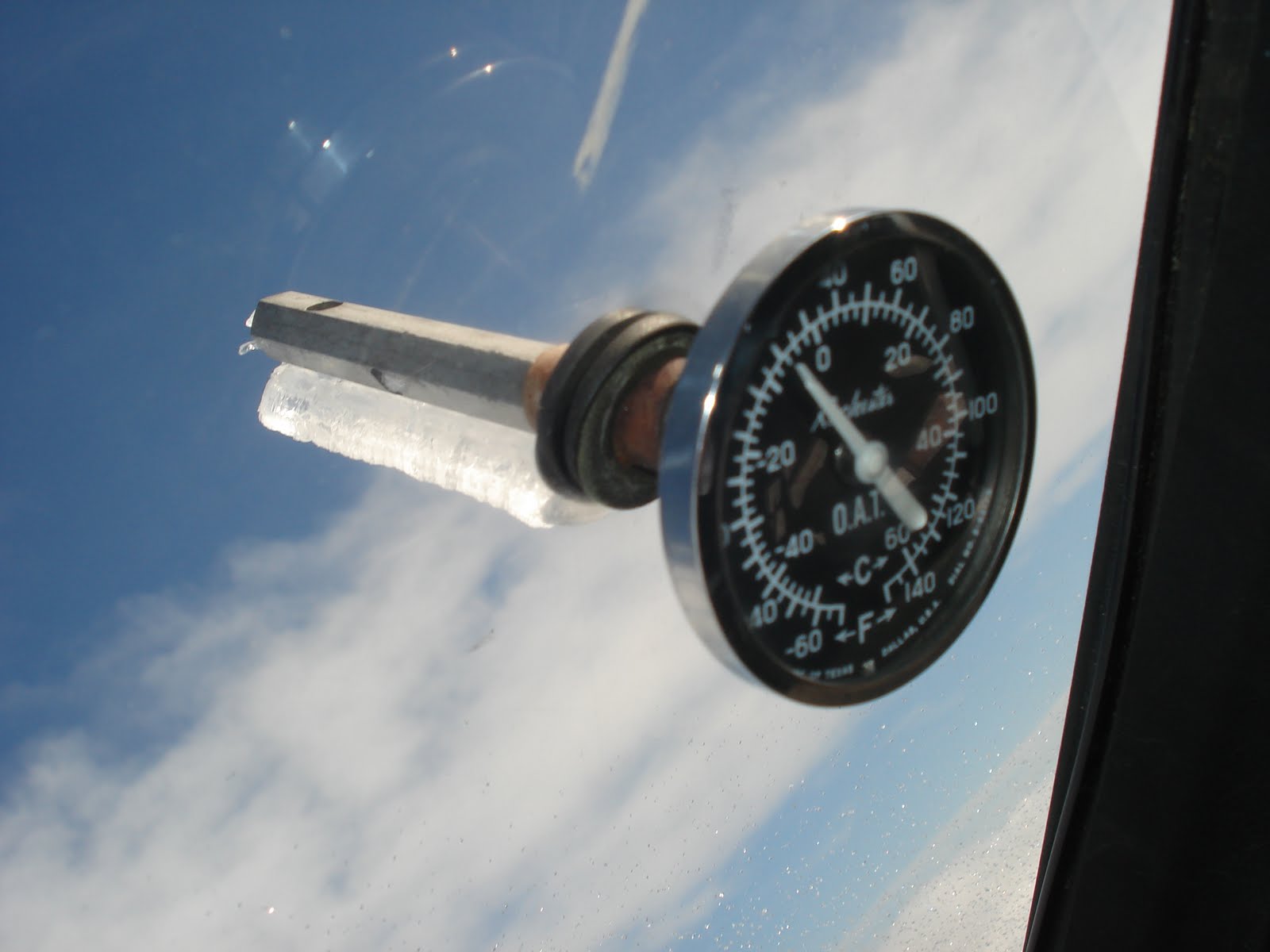
Ice sticking to the OAT probe
We were given clearance to route all the way to the MTL VOR, some 150 nautical miles away. As the route was fairly straight anyway this didn't make too much difference, but was good to hear nonetheless. We could see the cloud tops rising to meet our level ahead, so I requested a 1000' climb to FL110 which was readily granted and kept us clear of the clouds and further icing conditions. The temperature outside was a chilly -6C and I'm sure the ice would have stuck to us at an alarming rate.
As per the forecast we'd seen both at home and in Bourges, there were a few buildups which rose above the FL100 or so cloud tops to something like FL140, and one of these was right in our way. A quick request to ATC to deviate right to avoid weather was granted and so we did. When we were approaching a point at which we could turn back towards MTL ATC asked us how long before we would be able to do so; I told them another 5 minutes would do it and they seemed fine with this answer.
The weather system that was bothering south eastern France came with some winds, and typically these were headwinds for us (aren't they always?) with the result that the 2:10 planned flight took us 2:45 making our touchdown time at Cannes 6:50pm. We taxyed straight to the fuel pumps, reasoning that a short delay now was better than any delay on the return journey and potentially missing our flight planned departure time or slot if we had one. We pulled up at pump 2 as there was a Jodel already waiting at pump 1, but there were no fuellers to be seen. The Jet A1 truck was out fuelling up the business jets of the rich and famous - the Cannes film festival is on at the same time as the Monaco grand prix, making this weekend Cannes airport's busiest throughout the year. I checked with the Jodel pilots, and found out that they had been waiting just a few minutes. Before long an airport official came over on a golf cart to tell us that the fuellers would be along in about 20 minutes. I asked if we would be better waiting until Monday morning and he confirmed what we thought; that the potential for delays on Monday was far greater.
Something like 30 minutes later, the fueller arrived. All he had to do was throw a switch to enable the pumps. Surely he could have taken 30 seconds from his jet refuelling time to do that for us! Another aircraft had joined the fuelling queue in the meantime. I dispensed the 115 litres of avgas (not bad for 2:45 of flight!) paid in the fuel office and we all boarded again to taxy to our parking stand. The ground controller asked how long we would be staying and after confirming that (as booked) we were there for the weekend, we were directed to park on the opposite eastern side of the airport on the grass. After parking the aircraft we unloaded our luggage and a neat airport van collected the crew of an aircraft parked next to us. We were ready moments after they had driven away but thought they would be back soon. 25 minutes later, and (sod's law) with me having unpacked a headset and climbing into the aircraft to call ground and ask how much longer we would be expected to wait, the van returned. It proceeded to collect 5 more people from helicopters that had landed in the meantime and then return to the terminal.
There was just one taxi waiting, so while the others collected our luggage I was out of the van door first and went straight to the driver, asking him to take us to the train station. Finally, something had happened without any delay!
Flying to the Monaco GP, part 1
For the last few years, myself and another pilot have made our way to Cannes (LFMD) with the ultimate aim of attending the Monaco Grand Prix. The routes have been varied, and each year we take another passenger or two but to date have always been in four seat single engine piston aircraft. This year, as last year, we would be making the journey in my Commander. The passenger would be my father and the simplest way to achieve this, with the Commander being based at Liverpool, my dad near Gloucester and Mark in the London area, would be to make a couple of stops to collect people on the way.
This year we chose not to be there for the practice sessions on Thursday. At most Grands Prix, these are on the Friday but Thursday practice is just one of the many ways that Monaco is a bit different to the rest. We chose, therefore, to fly down on Friday and return on Monday. After work on Thursday afternoon, I drove to the airport and made a simple VFR flight to Gloucester at around 2,000ft. There is very little in the way of airspace between Liverpool and Gloucester so once out of the Liverpool zone at Chester the routing is a case of telling the GPS I want to go to EGBJ and following the magenta line. On radio contact with Gloucester I offered to make an SRA approach as they are currently training new controllers but was told that the trainee wasn't around so I made a simple right base join for runway 22. In order to save some time in the morning, I fuelled up at this point before parking for the night and being collected to spend the night with my parents.

Returning the next morning with the intention of being off blocks at 0900, we ended up moving at about 0920. After beginning the taxi to the threshold of runway 22, we were asked to wait for a locally based training twin. This proceeded to take a rather long time for the student to complete checks at the holding point, then longer to receive an IFR clearance, even longer to put up IR screens and ended up delaying us by more than 10 minutes. Would it really have been such a pain for them to taxi behind us? Gloucester is normally a slick operation but this was a poor example of sequencing.
We set off in the direction of Fairoaks (EGTF) and again the navigation was little more than a straight magenta line between the two. With the help of Brize Norton allowing us to cross their zone and a very short dogleg towards the end to avoid the south western point of the Heathrow CTR the flight was uneventful, culminating in a downwind join for Fairoaks' runway 24. Mark was waiting for us at the aircraft's parking spot and within 10 minutes we were starting the engine again for the IFR next leg into France...
This year we chose not to be there for the practice sessions on Thursday. At most Grands Prix, these are on the Friday but Thursday practice is just one of the many ways that Monaco is a bit different to the rest. We chose, therefore, to fly down on Friday and return on Monday. After work on Thursday afternoon, I drove to the airport and made a simple VFR flight to Gloucester at around 2,000ft. There is very little in the way of airspace between Liverpool and Gloucester so once out of the Liverpool zone at Chester the routing is a case of telling the GPS I want to go to EGBJ and following the magenta line. On radio contact with Gloucester I offered to make an SRA approach as they are currently training new controllers but was told that the trainee wasn't around so I made a simple right base join for runway 22. In order to save some time in the morning, I fuelled up at this point before parking for the night and being collected to spend the night with my parents.

En route to Gloucester
Returning the next morning with the intention of being off blocks at 0900, we ended up moving at about 0920. After beginning the taxi to the threshold of runway 22, we were asked to wait for a locally based training twin. This proceeded to take a rather long time for the student to complete checks at the holding point, then longer to receive an IFR clearance, even longer to put up IR screens and ended up delaying us by more than 10 minutes. Would it really have been such a pain for them to taxi behind us? Gloucester is normally a slick operation but this was a poor example of sequencing.
We set off in the direction of Fairoaks (EGTF) and again the navigation was little more than a straight magenta line between the two. With the help of Brize Norton allowing us to cross their zone and a very short dogleg towards the end to avoid the south western point of the Heathrow CTR the flight was uneventful, culminating in a downwind join for Fairoaks' runway 24. Mark was waiting for us at the aircraft's parking spot and within 10 minutes we were starting the engine again for the IFR next leg into France...
Subscribe to:
Posts (Atom)